


How to Play Calcudoku: Rules, Cages and First Steps
Calcudoku is a logic puzzle with a little arithmetic. You fill a square grid so that every row and every column holds each number once. The grid is also split into outlined groups called cages, and the numbers in each cage must make its target with the operation shown. On a 6×6 grid you use the numbers 1 to 6. The sums are small; the real work is logic.
The rules of Calcudoku
- Each row holds the numbers 1 to the grid size, once each.
- Each column holds them once each, too. Unlike sudoku, there are no boxes.
- Each cage has a target and an operation in its corner, such as 7+ or 12×. The numbers in the cage must give that target.
- For − and ÷, the cage has two cells. Take the bigger number first: a 3− cage can be 4 and 1, in either order.
- A number may repeat inside a cage, as long as it does not repeat in its row or column.
- A cage of one cell is simply a given number.
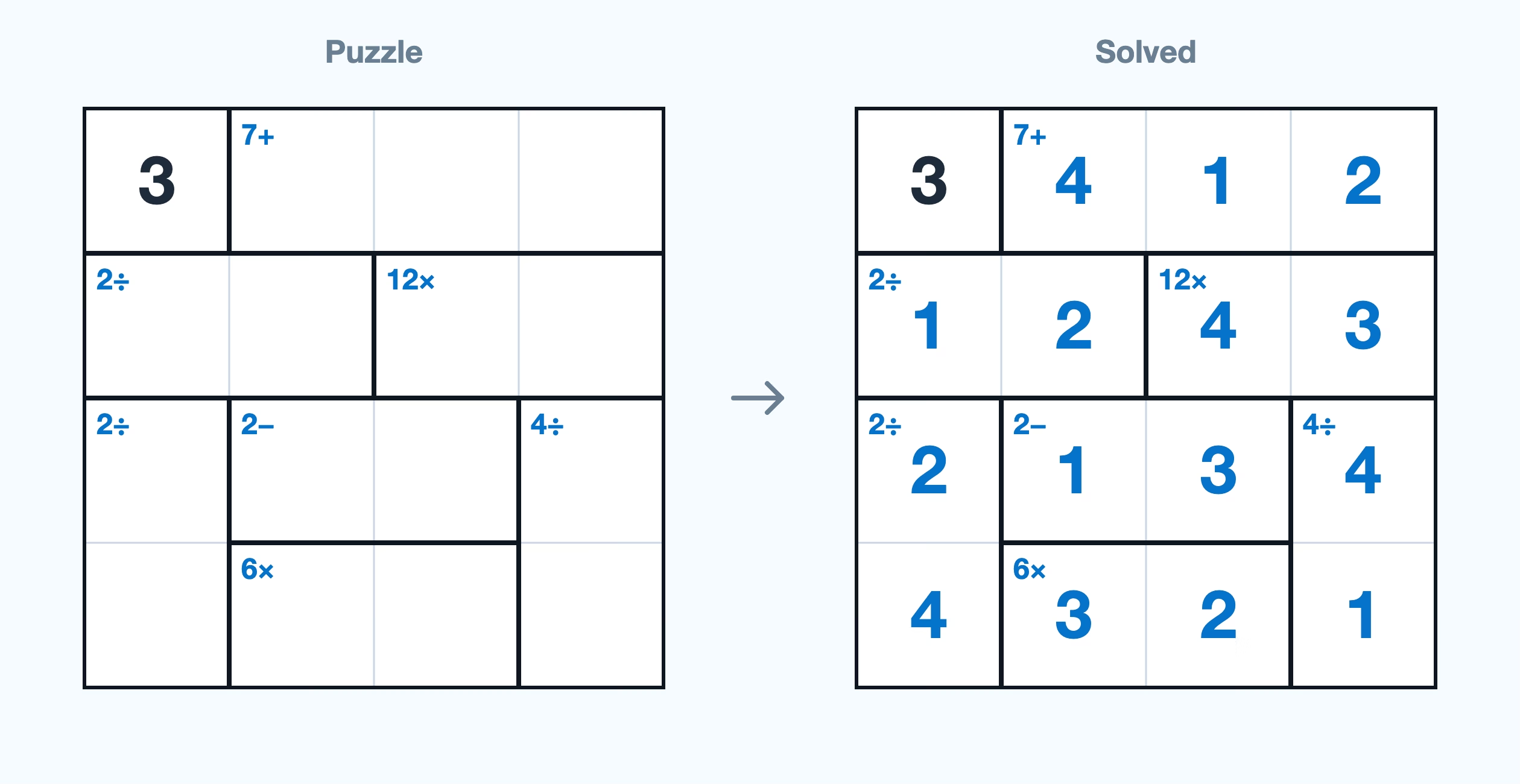
The small example above uses a 4×4 grid, so the numbers are 1 to 4. Check the solved side: the 12× cage holds 4 and 3, the 2− cage holds 1 and 3, and the 7+ cage holds 4, 1 and 2.
How to read a cage
Before you place anything, ask: which pairs of numbers can make this target? On a 6×6 grid the answer is often short.
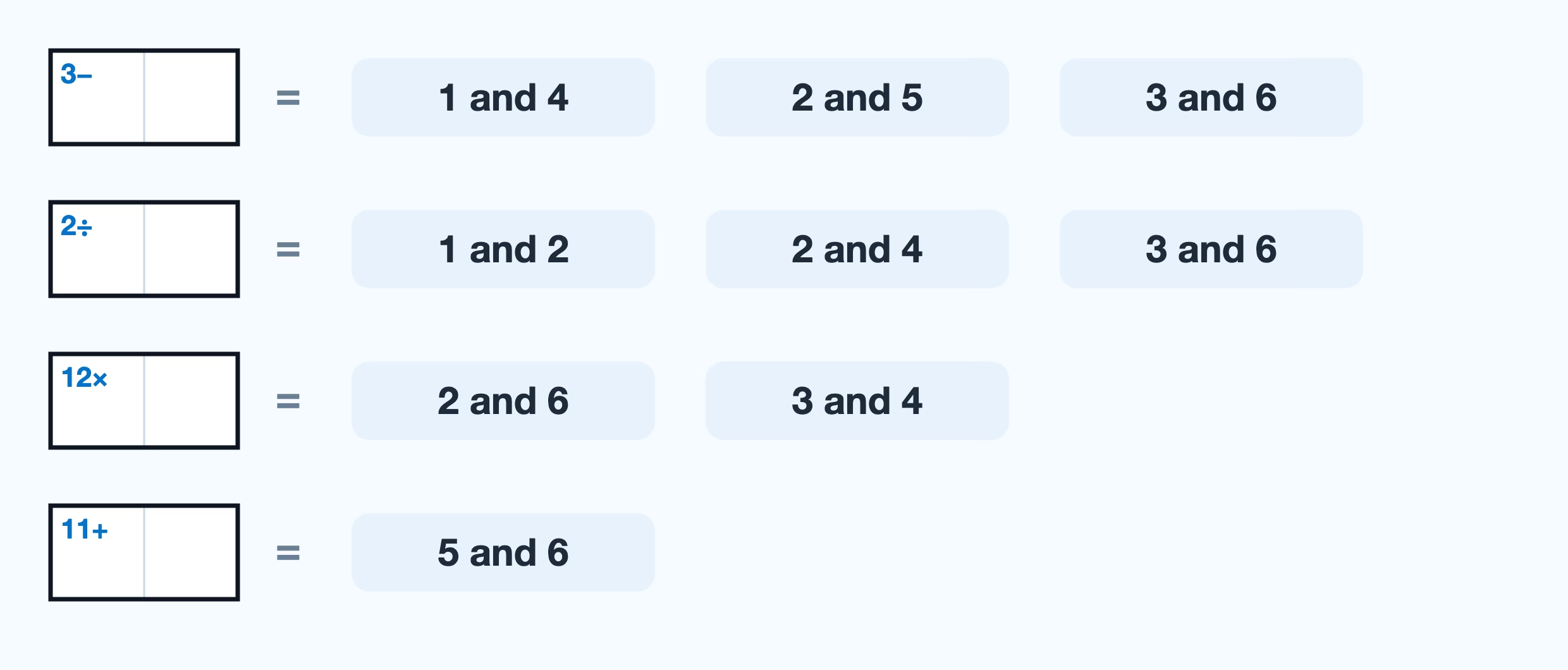
Some targets leave only one pair. An 11+ in two cells on a 6×6 grid must be 5 and 6. Others leave two or three pairs, and the row or column then decides. Very large products and very small sums are usually the easiest cages, because few numbers fit.
How to solve your first Calcudoku
Walk through the 4×4 example:
- Start with the given number. The 3 in the corner is already placed, so the rest of the first row holds 1, 2 and 4.
- Check what that means for a cage. Those three cells are the 7+ cage, and 1 + 2 + 4 is 7. The row and the cage agree, so you only need the order.
- Find cages with one answer. On a 4×4 grid, 4÷ can only be 4 and 1, and 12× in two cells can only be 3 and 4.
- Cross rows and columns. Once a 4 sits in one cell of a cage, its row and column cannot have another 4. That often decides the next cage.
Use Notes to write the possible numbers in a cell, and remove them as the grid fills in. If you place a number that breaks a rule, the game marks it. Undo and Erase let you fix it without starting over.
Playing Calcudoku on Sudoku Pro
Our Calcudoku is a 6×6 grid with the numbers 1 to 6, free in your browser. The four levels change the cages:
- Easy: cages of up to 2 cells, with + and × only.
- Medium: cages of up to 3 cells, and − joins in.
- Hard: all four operations, cages of up to 3 cells.
- Expert: all four operations, cages of up to 4 cells.
Hints fill in one cell when you would like help, and a timer runs at the top if you are curious about your time. For a puzzle with sums only, try Kakuro. For a puzzle with no arithmetic at all, try Futoshiki, where signs compare neighbouring numbers.
FAQ
- The idea is the same: a grid where each number appears once per row and column, split into cages with arithmetic targets. KenKen is a trademarked name for this type of puzzle.
- Always the bigger number first. A 2÷ cage can be 4 and 2 in either order, because 4 ÷ 2 = 2.
- Yes, if the two cells are in different rows and columns. It still cannot repeat in its own row or column.
- No. The sums and products are small. Most of the work is logic about rows, columns and cages.

Killer Sudoku
Sum the cages · Master the puzzle

Get Mobile App
Play sudoku on your phone with no limits

