


How to Play Futoshiki: Rules, Signs and Tips
Futoshiki is a number puzzle with greater-than and less-than signs. You fill a square grid so that every row and every column holds each number once, and every sign between two cells is true. On a 5×5 grid you use the numbers 1 to 5. The name is Japanese and means "not equal". There is no arithmetic: you only compare which number is bigger.
The rules of Futoshiki
- Each row holds the numbers 1 to the grid size, once each.
- Each column holds them once each, too.
- A sign between two neighbouring cells must be true. The open side of the sign faces the bigger number: in 4 > 2, the 4 is bigger.
- Signs between cells in a column point up or down. A ∨ means the upper cell is bigger; a ∧ means the lower cell is bigger.
A few numbers are already filled in at the start. Everything else follows from the rows, the columns and the signs.
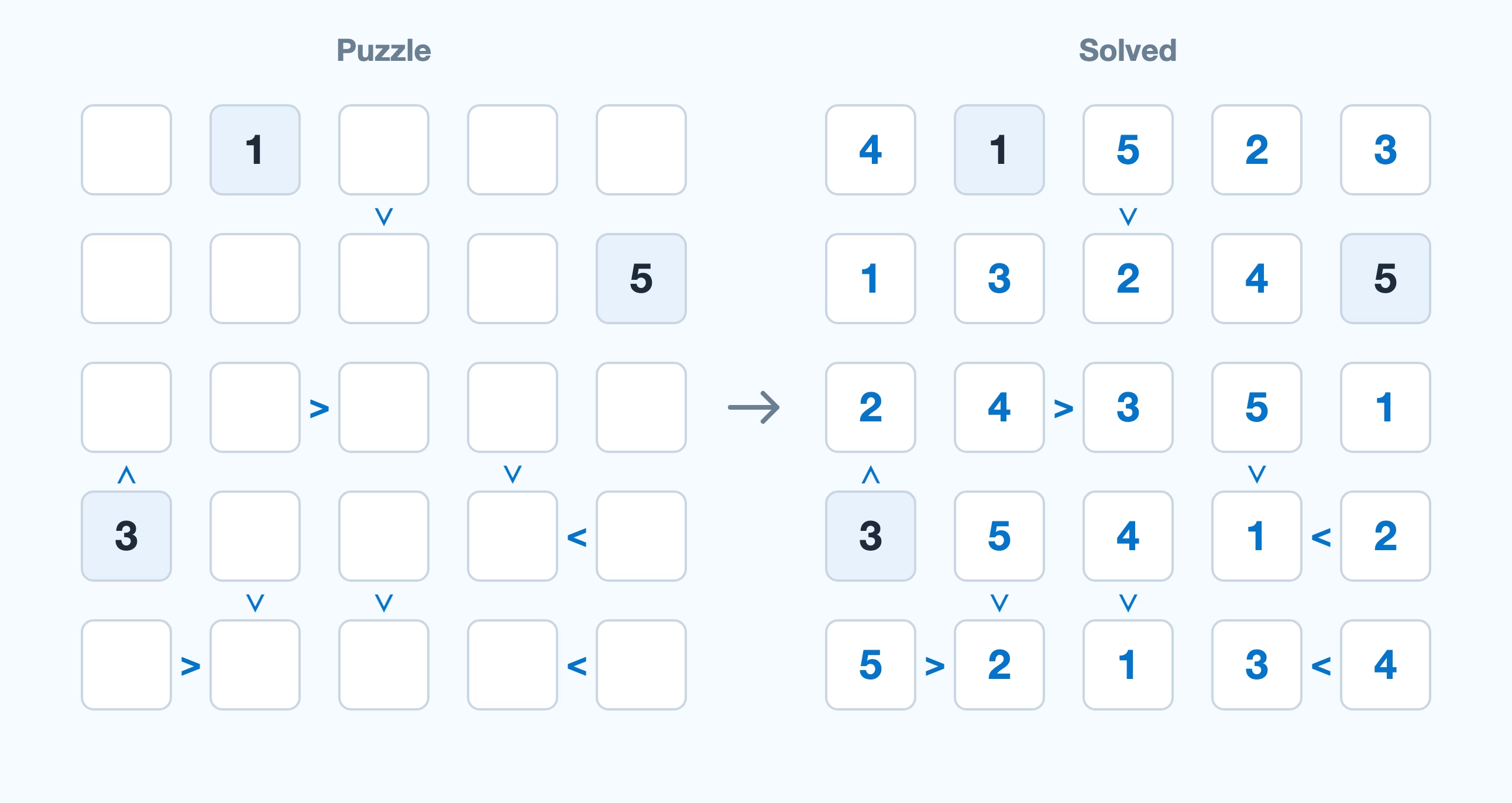
Check the solved grid in the picture. In the third row, 4 > 3 is true. In the first column, the ∧ between 2 and 3 says the lower cell is bigger, and it is. Every row and column holds 1 to 5 once.
What a sign tells you
One sign already removes options. The cell on the small side of a sign can never hold the largest number, because nothing would be bigger than it. On a 5×5 grid, that cell cannot be 5. In the same way, the cell on the big side can never be 1.
Signs in a row are even stronger when they form a chain. Look at four cells joined by three signs: a < b < c < d.
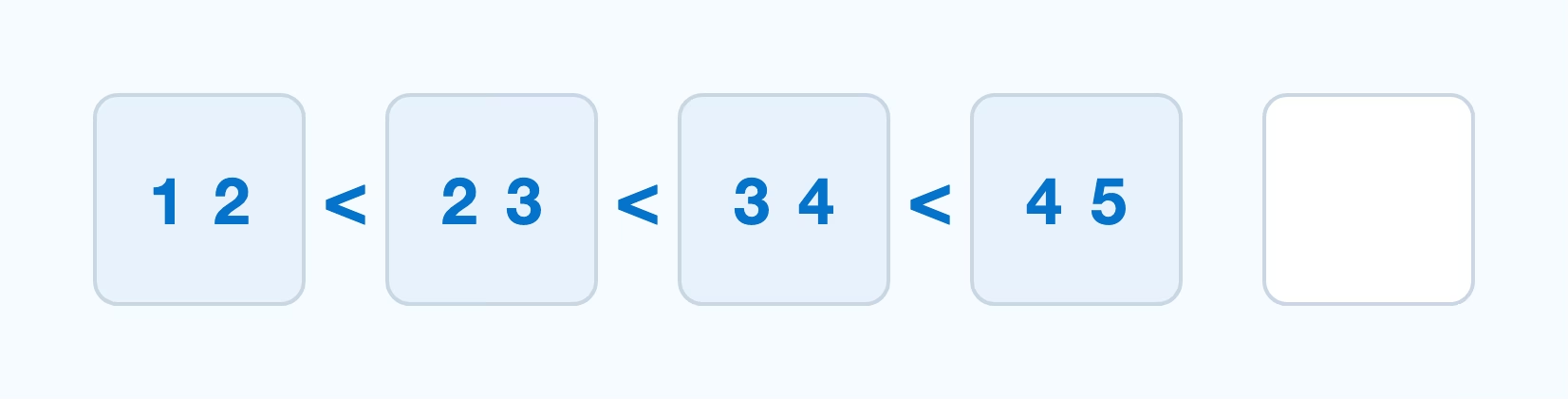
The first cell needs three bigger numbers after it, so on a 5×5 grid it can only be 1 or 2. The last cell needs three smaller numbers before it, so it can only be 4 or 5. Each cell in this chain keeps just two candidates. One more clue anywhere in that row can settle all four at once.
How to solve your first Futoshiki
- Mark the edges of every sign. Remove 5 from each cell on the small side and 1 from each cell on the big side. Notes are made for this.
- Follow the chains. Count how many cells are smaller or bigger than each one, as in the picture above.
- Scan rows and columns, as in sudoku. Say a row is missing only 2 and 4. If one of its empty cells must be bigger than a 3 next to it, that cell is 4.
- Use every number you place. A new number removes itself from its row and column, and it may make a nearby sign decide its neighbour.
Work in small, sure steps. If a number turns out wrong, the game marks the clash, and Undo takes your last moves back.
Playing Futoshiki on Sudoku Pro
Our Futoshiki is a 5×5 grid with the numbers 1 to 5, free in your browser. There are four levels. On Easy, 8 to 10 numbers are filled in and most neighbouring cells have a sign between them. On Medium and Hard there are fewer of both. On Expert, only 2 or 3 numbers are given and the signs are sparse, so the chains matter most.
You can keep candidates with Notes, clear a cell with Erase, take back moves with Undo, and ask for Hints when you would like help with one cell. If you enjoy comparing numbers, try Skyscrapers, where clues outside the grid count visible buildings, or Jigsaw Sudoku with its oddly shaped regions.
FAQ
- It is Japanese for "not equal", after the greater-than and less-than signs between the cells.
- No arithmetic at all. You only decide which of two numbers is bigger.
- The open side faces the bigger number, as in 4 > 2. In a column, ∨ means the upper cell is bigger and ∧ means the lower cell is bigger.
- It is a 5×5 grid with the numbers 1 to 5, on four levels from Easy to Expert.

Killer Sudoku
Sum the cages · Master the puzzle

Get Mobile App
Play sudoku on your phone with no limits

