


How to Play Kakuro: Rules, Sums and First Steps
Kakuro is a number crossword. You fill the white cells with the digits 1 to 9. Each line of white cells must add up to the number in its clue. A digit cannot repeat inside one sum. That is the whole rule. You need only addition, and the rest is calm, careful logic.
The rules of Kakuro
The board has dark clue cells and white cells. A line of white cells next to each other, across or down, is called a run. Every run starts at a dark cell with a number in it.
- The number above the diagonal line is the sum of the run going across, to the right.
- The number below the diagonal line is the sum of the run going down.
- Each white cell holds one digit from 1 to 9. Zero is not used.
- A digit appears only once in a run. A two-cell run of 4 is 1 + 3, never 2 + 2.
Every white cell sits in two runs, one across and one down. So each digit you write must fit both sums at once. That crossing is where the puzzle gives you its answers.
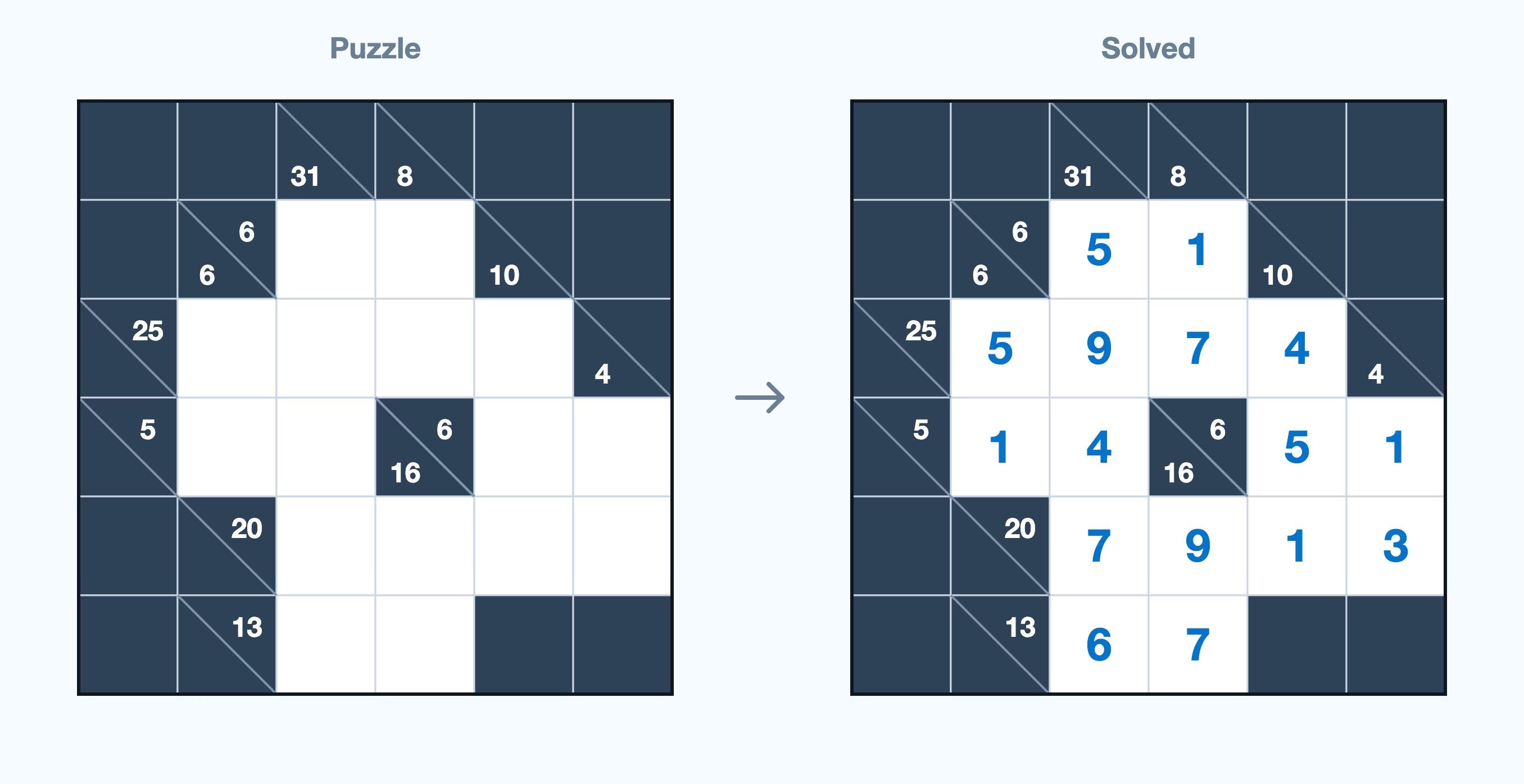
In the picture, the 13 across at the bottom is solved with 6 and 7. Those same cells are also part of the 31 down and the 16 down. Check any run on the right: the digits add up to its clue, and none repeats.
Sums with only one answer
Some sums can be made in only one way. These are the best place to start, because they give you certain digits, not guesses.
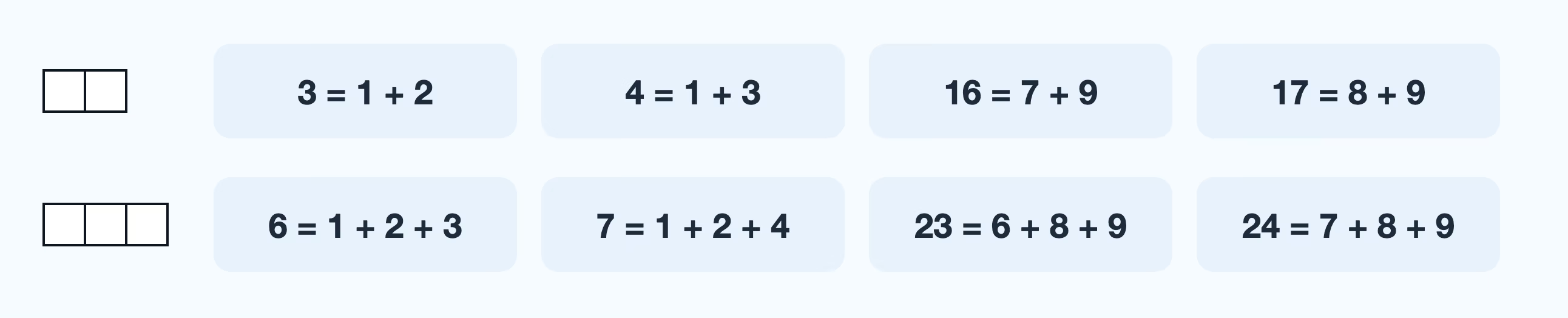
- In two cells: 3 is 1 + 2, 4 is 1 + 3, 16 is 7 + 9, and 17 is 8 + 9.
- In three cells, small: 6 is 1 + 2 + 3, and 7 is 1 + 2 + 4.
- In three cells, large: 23 is 6 + 8 + 9, and 24 is 7 + 8 + 9.
You do not need to memorise more than this at first. The order of the digits is still open: a 4 in two cells can be 1 then 3, or 3 then 1. The crossing run decides which.
How to solve your first Kakuro
Look at the example board again. The 4 down on the right covers two cells, so it must be 1 and 3. The 16 down in the middle covers two cells, so it must be 7 and 9. Two runs are narrowed to a known pair before you write anything.
Now use the crossings. The top cell of the 16 down also belongs to the 20 across of four cells. The bottom cell belongs to the 13 across of two cells. The shared cell must be 7 or 9. If it is 9, its partner in the 13 across is 4; if it is 7, the partner is 6. Small steps like this, one crossing at a time, fill the whole board.
A few habits help:
- Start with short runs and the extreme sums. They have the fewest options.
- Write the possible digits in a cell with Notes, then cross them out as the crossing runs rule them out.
- When a run has one empty cell left, its digit is simply the clue minus the digits already there.
- Remember the largest digit a cell can take. In a two-cell run of 5, neither cell can be 5 or more.
Playing Kakuro on Sudoku Pro
Our Kakuro is played on a 6×6 board, clue cells included, right in your browser. There are no levels to pick: each New Game brings a fresh board. If a digit breaks a rule, the game marks it, so you can fix it with Erase or Undo. Notes let you keep candidates in a cell, and Hints fill in a cell when you would like a nudge. A timer runs at the top, but there is no hurry: a slow, clean solve is a good solve.
If Kakuro is new to you, our comparison of Sudoku and Kakuro shows how the two puzzles feel different. For more number logic, try Calcudoku, where cages use all four operations, or Futoshiki with its greater-than signs.
FAQ
- Not inside one run. The same digit can appear again in another run, in a different row or column of the board.
- No. Every white cell holds a digit from 1 to 9.
- No. You only add small numbers. Most of the puzzle is logic: which digits fit two crossing sums at once.
- Look for runs with only one possible set of digits, such as 3 or 4 in two cells, or 23 or 24 in three cells.


Killer Sudoku
Sum the cages · Master the puzzle

Get Mobile App
Play sudoku on your phone with no limits

