


Sudoku or Crossword: Which Puzzle Fits Your Day?
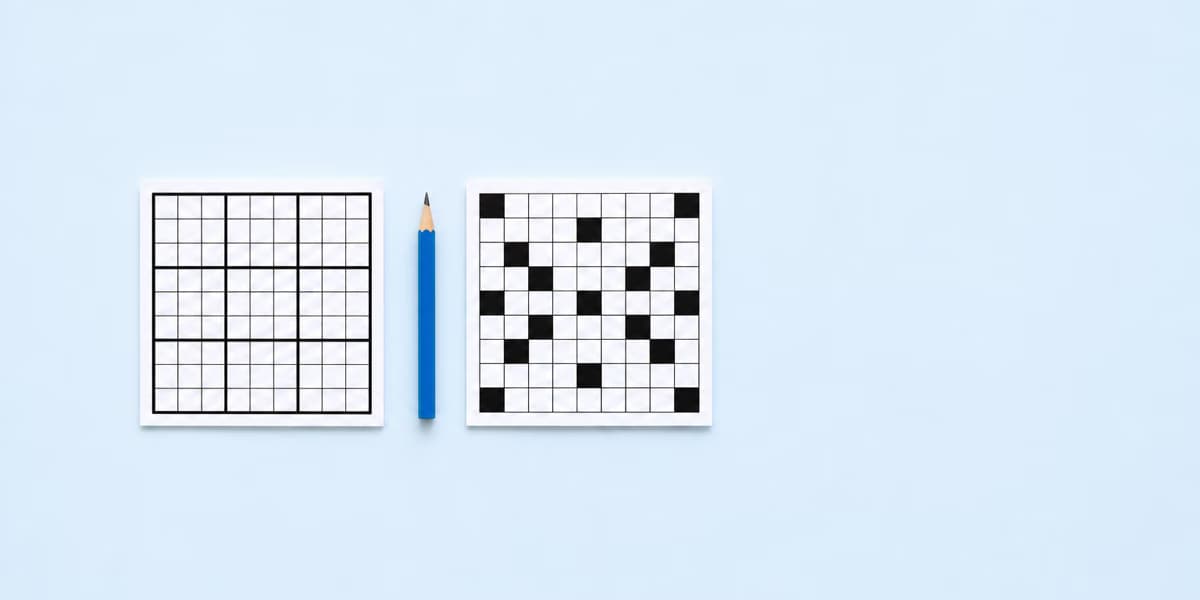
If you enjoy reasoning step by step and want a puzzle that never depends on what you happen to know, sudoku is the better fit. If you love words, general knowledge and the small joy of a clever clue, choose the crossword. Many people keep both: a crossword with the morning paper, a sudoku in a quiet moment later in the day. Here is how the two really differ, so you can choose the one that suits your day.
How are sudoku and crosswords different?
A sudoku is a 9×9 grid. You place the digits 1 to 9 so that every row, every column and every 3×3 box holds each digit once. There is no arithmetic at all: the digits are just nine different symbols. Everything you need to finish is already on the page. Our article on the logic behind sudoku explains why it is a puzzle of reasoning, not of maths.
A crossword works the other way round. The grid is only a frame. The real puzzle is in the clues, and the answers come from your memory: words, names, places, a little history. Crossing answers help, but if you simply do not know a word, a gap may stay empty until someone tells you.
Both puzzles have a long story. The first crossword is usually credited to Arthur Wynne, who published it in a newspaper in December 1913 (Wikipedia). Sudoku is younger: it first appeared in 1979 under the name Number Place, as told in our history of sudoku.
Which one is easier to start?
Sudoku is easier on the very first day. The rules fit in one sentence, and an easy puzzle gives you a lot of help. On our Easy level, 45 of the 81 cells are already filled in, so the first digits come quickly. Our guide for beginners walks you through a first full puzzle.
A crossword has simple rules too, but how hard it feels depends on your vocabulary and on the person who wrote the clues. Some crosswords use a style of clue that takes practice to read. And a crossword in your second language is much harder than one in your first.
Sudoku has no language at all. A puzzle printed in Japan, Brazil or Poland is solved exactly the same way.
How do they feel to solve?
Sudoku gives steady, quiet progress. Each certain digit opens the way to the next one, and at the end you have a full grid that you know is right. When you get stuck, there is always a logical next step somewhere, even if it takes a while to find. You never need to guess: here is how to solve hard puzzles without guessing.
A crossword comes in bursts. An answer can pop into your head while you make tea, an hour after you read the clue. It is also easy to share: reading a clue out loud to someone at the table is half the fun.
Is one of them better for the mind?
Both keep your mind busy, and both are pleasant ways to spend a quiet half hour. The research on puzzles and brain health is mixed, and most studies show links rather than clear cause and effect. We looked at what the studies really say in Is Sudoku Good for Your Brain?
The honest answer is simple: choose the puzzle you enjoy. Enjoyment is what turns a puzzle into a habit you keep.
How do you choose for your day?
| Sudoku | Crossword | |
|---|---|---|
| What it asks of you | logic and patience | words and general knowledge |
| Language | none, only digits | your best language |
| When you are stuck | a logical next step always exists | crossing answers, or a friend |
| A good moment for it | a quiet moment on your own | the morning paper, or solving together |
There is no wrong choice. Some people solve a crossword with breakfast and a sudoku in the evening, when the house is quiet. Others switch days. If you like a routine, a daily puzzle is a gentle way to keep one.
Ready for today's puzzle?
Our free Sudoku Pro app has a new easy puzzle every day, and a cup for every month you complete. Regular puzzles work offline, and the app has notes, hints and a dark theme for the evening. You can get it on Google Play or the App Store.
Prefer the browser? Start with an Easy sudoku right here, with nothing to install. And if you know a crossword lover, share this with them: they may enjoy a sudoku too.
FAQ
- No. Sudoku uses digits only as symbols, so there is nothing to add or multiply. You could play the same puzzle with nine colours or nine letters.
- Yes. A sudoku has no words at all, so it is solved the same way everywhere, and our app and website are available in many languages.
- The daily puzzle in our Sudoku Pro app is always an Easy one, so it is a gentle way to start a habit.
Killer Sudoku
Sum the cages · Master the puzzle
Similar Articles

Inside the Logic of Sudoku: Why It Is Logic, Not Maths
Why sudoku is a puzzle of logic rather than arithmetic: digits as symbols, one rule that decides every cell, the two questions behind every step, and the real maths around the grid.
Sudoku vs Kakuro: Differences and Which Puzzle Suits You
Sudoku and Kakuro side by side: the rules of each, a first Kakuro step, how the two feel different, who may prefer which, and Killer Sudoku as the puzzle in between.

How to Play Sudoku for Beginners: Your First Puzzles
Your first sudoku, step by step: which puzzle to choose, how a game goes in Sudoku Pro, where to look first, playing on paper and what to do when you are stuck.
Killer Sudoku
Sum the cages · Master the puzzle

Get Mobile App
Play sudoku on your phone with no limits

