


How to Play Jigsaw Sudoku: Rules, Regions and Tips
Jigsaw Sudoku is sudoku with oddly shaped boxes. Instead of neat squares or rectangles, the grid is split into regions that look like jigsaw pieces. Each row, each column and each region holds every number once. On a 6×6 grid you use the numbers 1 to 6, and there are six regions of six cells. If you know classic sudoku, you already know almost everything.
The rules of Jigsaw Sudoku
- Each row holds the numbers 1 to the grid size, once each.
- Each column holds them once each, too.
- Each region, the shape with the thick outline and its own colour, holds them once each.
- Some numbers are given at the start. You fill in the rest.
That is the only change from classic sudoku: the regions follow their own shapes. A region can stretch across three rows, turn a corner or wrap around another region.
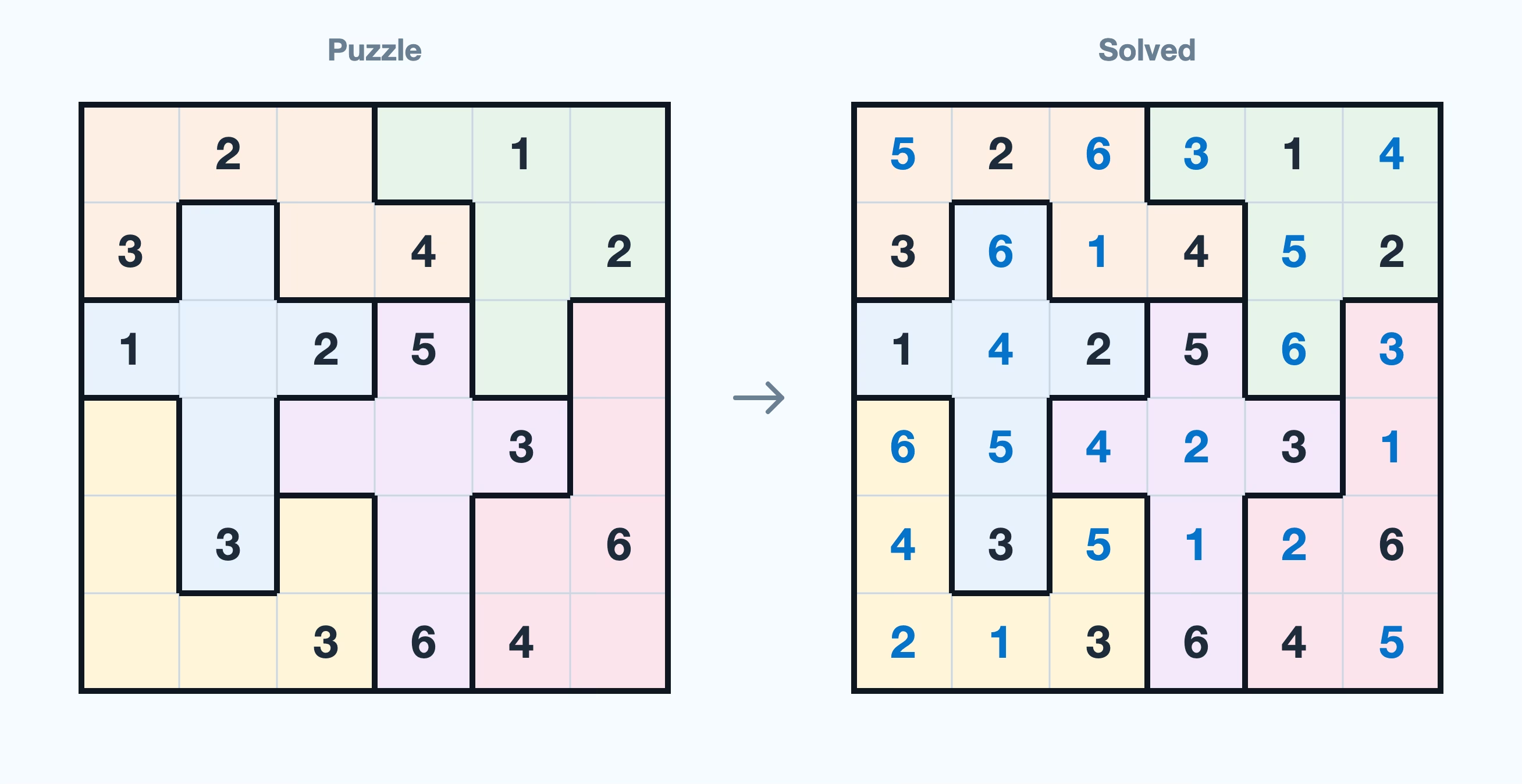
Check any colour on the solved side. The light blue region, shaped like a cross, holds 1 to 6 once each, just like every row and every column.
Why the shapes help you
In classic sudoku, a box always covers the same rows and columns, so you learn where to look by habit. In Jigsaw, every region is different, and that is useful. A region spread over many rows and columns meets many other numbers. Each of those numbers can rule out a cell.
The most common first step is to pick one region and one missing number, then ask: where in this region can it go?
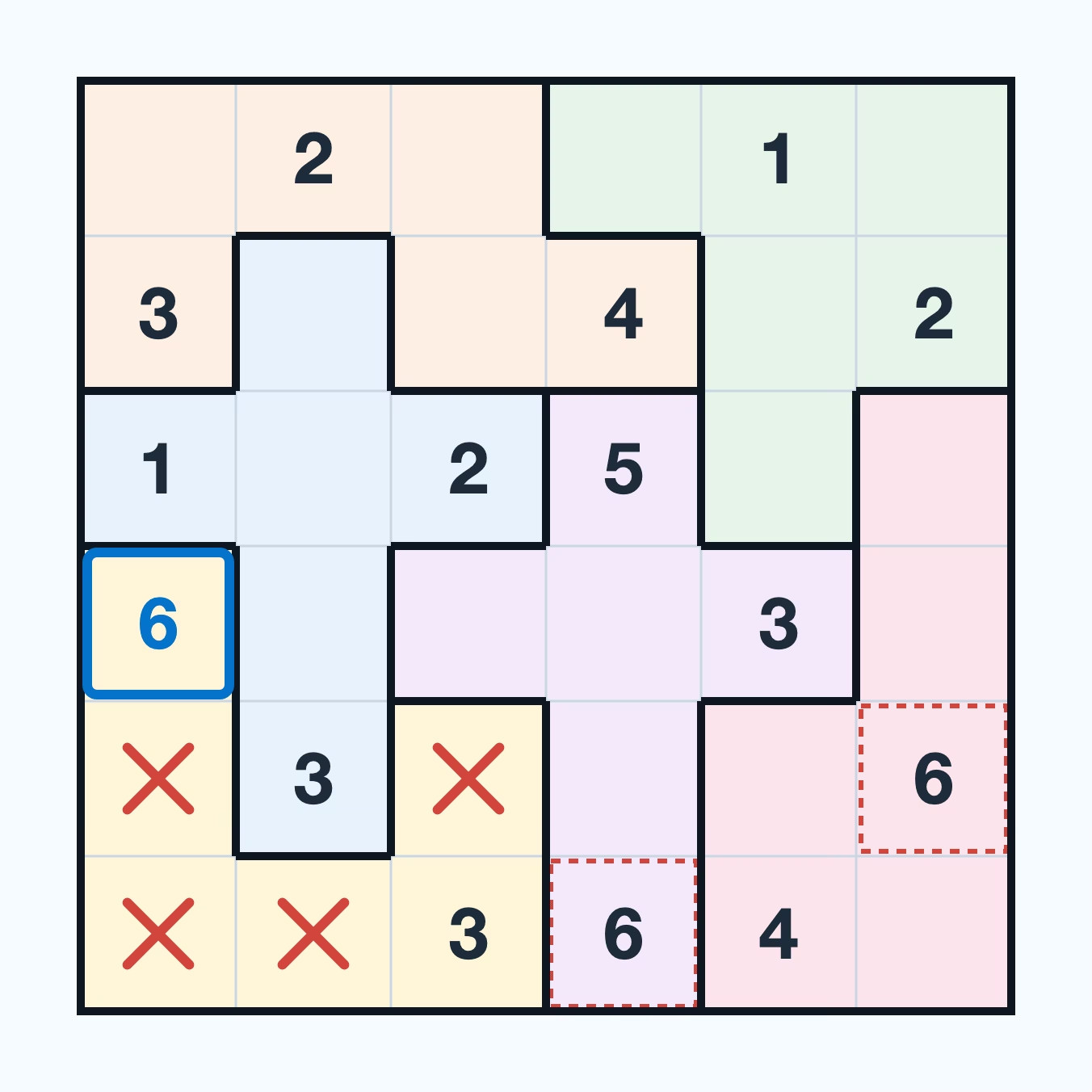
Here the yellow region in the bottom left still needs a 6. Its two cells in the fifth row are out, because that row already has a 6 on the right. Its two empty cells in the bottom row are out too, because the bottom row has a 6 in the middle. One cell is left, so the 6 goes there.
How to solve your first Jigsaw Sudoku
- Start with the fullest region. If it has five numbers, the sixth is the missing one.
- Follow one number through the regions, as in the picture above. Check each empty cell against its row and column.
- Watch the thin parts. Where a region touches a row in one or two cells, those cells are often the only place for one of its numbers.
- Use Notes when nothing is obvious. Write the possible numbers in the cells of one region. A cell with one note left is solved.
If a number clashes with its row, column or region, the game marks it. Erase removes it and Undo takes back your last moves.
Playing Jigsaw Sudoku on Sudoku Pro
Our Jigsaw Sudoku is a 6×6 grid with six coloured regions, free in your browser. The four levels differ in how many numbers are given at the start. Easy gives 20 to 24 and Medium 14 to 19. Hard gives 10 to 13, and Expert only 8 to 10. If the shapes are new to you, start on Easy: they take a few grids to get used to.
Hints fill in one cell when you would like help. Our article on Jigsaw and classic sudoku compares the two in more detail. If you enjoy the 6×6 size with regular boxes, try 6×6 sudoku.
FAQ
- A sudoku where the boxes are irregular shapes instead of squares or rectangles. Each row, column and shape holds every number once.
- Not necessarily. The shapes make you look in new places, but they also give useful clues once you get used to them.
- Yes. Irregular sudoku and Jigsaw Sudoku are two names for the same idea.
- It is a 6×6 grid with the numbers 1 to 6 and six coloured regions, on four levels.

Killer Sudoku
Sum the cages · Master the puzzle

Get Mobile App
Play sudoku on your phone with no limits

