


Sudoku variants: 15 types, rules, and which to try first
Table of Contents
- Why my perspective will save you time
- What are Sudoku variants and how do they work?
- Which Sudoku variants should you try first? A comparison
- Rules for 15 popular Sudoku variants (clear, quick, and practical)
- How to choose your first Sudoku variants (a 3-step ramp)
- What works in practice: building a reliable solving plan
- Why Sudoku variants are worth your time
- Common mistakes when starting with Sudoku variants
- Key Takeaways
Sudoku variants: 15 types, rules, and which to try first
Sudoku variants add extra constraints to classic Sudoku, creating fresh logic challenges without guesswork. Start with gentle Sudoku variants like Diagonal or Jigsaw, then progress to Killer, Thermo, and Arrow.
If you can solve a standard 9×9, you can solve Sudoku variants. Pick one with a single new rule, learn the pattern it introduces, and practice on a few graded examples.
Why my perspective will save you time
I’ve constructed and test-solved hundreds of Sudoku variants for clubs, classroom workshops, and online platforms. The key lesson: difficulty comes from how constraints interact, not from obscurity. When you learn the logic behind a variant’s extra rule, your solves get faster and more enjoyable.
According to the general definition on Wikipedia, Sudoku is a placement puzzle over rows, columns, and 3×3 boxes. Sudoku variants preserve this structure but layer additional rules—lines, sums, or positional restrictions. Mentally engaging puzzles are also cited by the NIH and Mayo Clinic as beneficial for cognitive stimulation, making variants a smart way to train logic and focus.
To learn the base mechanics, use our step-by-step primer: How to play Sudoku for beginners. When you’re ready to explore, you can immediately practice these variants online at SudokuPro.
What are Sudoku variants and how do they work?
Sudoku variants are classic 9×9 puzzles with one or more extra constraints. These constraints restrict digit placement and create new deduction paths.
Common constraint types:
- Positional: Diagonal Sudoku (numbers 1–9 must also appear once on both main diagonals)
- Region shape: Jigsaw Sudoku (irregular regions replace 3×3 boxes)
- Arithmetic: Killer Sudoku (cages with sums), Arrow, Thermo, Sandwich
- Adjacency: Kropki (white/black dots), Consecutive, XV
Expert perspective: Constraints convert hard-to-see inferences into visible patterns. For example, a diagonal can force a hidden single early that would otherwise take longer to uncover.
Real-world tip: Start with Sudoku variants that add exactly one clear rule. Your classic toolset (scanning, singles, pairs, line-box interactions) will still carry most of the solve.
Which Sudoku variants should you try first? A comparison
Below is a practical, experience-based difficulty map to help you choose. Times assume a comfortable classic solver.
| Variant | Typical First-Time Solve | Core Skill Trained | Who Should Try |
|---|---|---|---|
| Diagonal (X) | 10–20 minutes | Cross-constraint scanning | Beginners stepping into variants |
| Jigsaw (Irregular) | 15–25 minutes | Region-based reasoning | Visual thinkers, box-line mastery |
| Hyper (Windoku) | 15–25 minutes | Overlapping region logic | Classic solvers ready for light spice |
| Killer | 25–45 minutes | Cage sums, combinatorics | Arithmetic lovers, patient solvers |
| Thermo | 20–35 minutes | Gradient ordering | Pattern spotters |
| Arrow | 25–45 minutes | Sum logic + flow | Comfortable with Thermo/Killer basics |
| Kropki | 25–40 minutes | Ratio/adjacency inference | Systematic note-takers |
| Sandwich | 30–60 minutes | Outside clues, counting | Meticulous counters |
| Anti-Knight | 15–30 minutes | Spatial exclusion | Chess/pattern minds |
| Renban | 20–35 minutes | Consecutive sets | Sequence thinkers |
As Kenji Takahashi, a World Puzzle Championship constructor, puts it: “Pick a variant with one extra rule and solve three in a row. By the third, your eyes auto-detect its signature patterns—and that’s when the fun really starts.”
For a gentle on-ramp, try Diagonal, Jigsaw, or Hyper first. If you enjoy arithmetic, add Killer, Thermo, and Arrow. To strengthen spatial exclusion, pick Anti-Knight or Skyscraper next.
Rules for 15 popular Sudoku variants (clear, quick, and practical)
Each entry includes rules at a glance, why to try it, and a starter tip.
1) Classic Sudoku (baseline)
- Rules at a glance: Fill digits 1–9 so each row, column, and 3×3 box contains each digit exactly once.
- Why try it: Foundation for all Sudoku variants; every technique transfers.
- Starter tip: Master singles, hidden singles, locked candidates, and simple pairs before moving on.
2) Diagonal Sudoku (X-Sudoku)
- Rules at a glance: Classic rules, plus both main diagonals must also contain 1–9 once each.
- Why try it: Adds just one global constraint; great first step into Sudoku variants.
- Starter tip: Pencil in diagonal placements for 1 and 9 early—extremes reveal quick eliminations.
3) Hyper Sudoku (Windoku)
- Rules at a glance: Classic rules, plus four extra shaded 3×3 regions must each contain 1–9.
- Why try it: Overlapping regions create elegant locked-candidate deductions.
- Starter tip: Treat each hyper-box like a mini box; cross-check with overlapping standard boxes.
4) Jigsaw Sudoku (Irregular)
- Rules at a glance: Classic rules, but 3×3 boxes are replaced by irregular shapes (still nine regions of nine cells).
- Why try it: Sharpens region visualization and line–region interactions.
- Starter tip: Outline each irregular region mentally; look for places where a region forces a digit into a single row or column.
5) Killer Sudoku
- Rules at a glance: Classic rules, plus dotted cages showing a total sum; no repeated digits in a cage. These are the core Killer Sudoku rules.
- Why try it: Builds combinatorics and arithmetic reasoning that transfer to Arrow/Thermo.
- Starter tip: Learn common cage sums (e.g., 2-cell 17 must be 8+9). Mark minimal/maximal combinations early.
6) Thermo Sudoku
- Rules at a glance: Classic rules, plus thermometers where digits strictly increase from bulb to tip.
- Why try it: Visual gradient makes ordering deductions intuitive.
- Starter tip: Place extremes first. A short three-cell thermo in a box often fixes a digit immediately.
7) Arrow Sudoku
- Rules at a glance: Classic rules, plus arrows where the circle digit equals the sum of digits along its arrow path.
- Why try it: Combines place-value intuition with sum logic; a natural follow-up to Thermo and Killer.
- Starter tip: Note viable sums for each circle. If a circle is 9, its arrow cells must add to 9 with Sudoku constraints.
8) Kropki Sudoku
- Rules at a glance: Classic rules, plus white dots indicate consecutive digits; black dots indicate one digit is double the other. Not all dots are given.
- Why try it: Teaches adjacency constraints and ratio reasoning.
- Starter tip: Use 1–2 and 5–10 (if allowed) reasoning; track where 1 and 9 can go because they limit double/consecutive options.
9) Consecutive Sudoku
- Rules at a glance: Classic rules, plus an indicator (often bars or dots) shows neighboring cells must be consecutive where marked; unmarked neighbors are non-consecutive.
- Why try it: Strengthens sequence logic and negative inference.
- Starter tip: A row packed with marked adjacencies quickly narrows where 1s and 9s can sit.
10) XV Sudoku
- Rules at a glance: Classic rules, plus an X between two cells means they sum to 10; a V means they sum to 5. Typically, not all X/V are shown.
- Why try it: Introduces targeted sum constraints with fast eliminations.
- Starter tip: Pair X’s with candidate pairs like (1,9), (2,8), (3,7), (4,6); V’s favor (1,4) or (2,3).
11) Sandwich Sudoku
- Rules at a glance: Classic rules, plus outside clues show the sum of digits between 1 and 9 in that row/column.
- Why try it: Demands precise counting and planning—excellent for disciplined notation.
- Starter tip: Large sandwich clues (e.g., 35+) imply many mid-range digits between 1 and 9; tiny clues imply tight clusters of small numbers.
12) Palindrome Sudoku
- Rules at a glance: Classic rules, plus gray palindromic lines where cells read the same forward and backward.
- Why try it: Adds reflective symmetry constraints that create clean pairs.
- Starter tip: Middle cell on an odd-length palindrome line is unrestricted by reflection; anchor your deductions there.
13) Renban Sudoku
- Rules at a glance: Classic rules, plus purple lines must contain a set of consecutive digits in any order.
- Why try it: Nurtures set-based reasoning with consecutive blocks.
- Starter tip: A 4-long renban can only be one of {1–4, 2–5, 3–6, 4–7, 5–8, 6–9}; eliminate impossible blocks via box/row/column pressure.
14) Skyscraper Sudoku
- Rules at a glance: Classic rules, plus outside clues state how many “buildings” are visible from that edge, assuming digit = height.
- Why try it: Enhances global planning and permutation pruning.
- Starter tip: Edge clues of 1 or 4 (on 4×4 examples) or 1 and 9-edge implications (on 9×9) create immediate anchors.
15) Anti-Knight Sudoku
- Rules at a glance: Classic rules, plus cells a knight’s move apart (as in chess) cannot contain the same digit.
- Why try it: Trains spatial exclusion and board-wide scanning.
- Starter tip: Use a placed 5 to eliminate every 5 a knight’s move away; sweeps across the grid create cascades of singles.
Additional note: Many Sudoku variants can combine rules (e.g., Diagonal + Killer). Start with single-rule puzzles before mixing.
How to choose your first Sudoku variants (a 3-step ramp)
- Strengthen the classic foundation
- Revisit singles, hidden singles, locked candidates, pairs/triples.
- If you’re new, learn the fundamentals in our beginner Sudoku walkthrough. This is essential for Sudoku for beginners.
- Add one gentle twist
- Try Diagonal Sudoku, Hyper Sudoku, or Jigsaw Sudoku.
- Goal: finish three puzzles of one type to internalize its signature deductions.
- Layer arithmetic or adjacency rules
- Move to Killer Sudoku, Thermo Sudoku, Arrow Sudoku, or Kropki/Consecutive/XV.
- Keep notes clean. Arithmetic variants reward careful candidate management.
When you’re ready to practice systematically, you can play graded variants free at SudokuPro, which helps you calibrate difficulty.
What works in practice: building a reliable solving plan
From coaching clubs and workshop cohorts, the fastest progress happens when solvers:
- Pick one variant and binge 3–5 of that type in a week.
- Keep a “pattern notebook” of recurring deductions (e.g., 2-cell-17 in Killer; bulb extremes in Thermo).
- Time early solves lightly (aim for completion, not speed), then review where the first decisive deduction appeared.
Practical example: In Thermo Sudoku, treat short thermometers like ordered cages. If a 3-cell thermo sits in a box with only two places left for 1, the thermo’s bulb can’t be too large—this resolves quickly.
Expert insight: Arithmetic variants (Killer, Arrow, Sandwich, XV) reward mental “min–max” checks. Before placing, ask: What’s the smallest and largest this set could be given the row/column/box? Those bounds often pin a digit.
Why Sudoku variants are worth your time
- Transferable skill: Pattern reading in Thermo/Arrow improves classic scanning.
- Measurable challenge: Many outlets grade variants so you can track progress. The New York Times popularized tiers in logic games, and the same graded approach helps with variants.
- Cognitive benefit: Brain-engaging tasks are widely associated with healthy aging by organizations like the Mayo Clinic and the NIH.
- Cultural staple: Global coverage from outlets like the BBC shows Sudoku’s enduring popularity and community, including variants.
If you want a clean definition anchor and historical context, see Sudoku on Wikipedia. It’s a good baseline before diving deeper into specific rule-sets.
Common mistakes when starting with Sudoku variants
- Skipping notes: Variants often need light candidate notation to track constraints.
- Mixing too soon: Don’t combine Diagonal + Killer + Thermo until you’re fluent in each separately.
- Ignoring the base: Most progress still comes from classic techniques. Use variant rules to unlock tough spots, not to replace fundamentals.
Key Takeaways
- Sudoku variants keep classic logic but add constraints; start with a single-rule type like Diagonal or Jigsaw.
- Build a progression: Classic fundamentals → gentle variants → arithmetic/adjacency types.
- Use structured practice: solve three of the same variant in a row to internalize patterns.
- Learn arithmetic sets for Killer/Arrow/Thermo; they also help in Sandwich and XV.
- Keep notes tidy and review first decisive deductions to improve consistency.
- Explore graded Sudoku variants online to calibrate your level and stay motivated.
FAQ
- Diagonal (X), Jigsaw (Irregular), and Hyper (Windoku) are the gentlest. Each adds one clear rule so classic techniques still do most of the work.
- In Killer, dotted cages show sums and can’t repeat digits, on top of standard row/column/box rules. You solve by using cage combinations and min–max logic.
- Killer, Arrow, Thermo, Sandwich, and XV sharpen sum reasoning, combinatorics, and min–max thinking.
- Gentle variants often take 10–25 minutes, while arithmetic-heavy or multi-rule puzzles can run 30–60 minutes depending on clue density and experience.
- No. Quality variants are logically solvable without guessing; each step follows from the given constraints and classic deduction.
Killer Sudoku
Sum the cages · Master the puzzle
Similar Articles

5 Must-Know Facts About Classical Sudoku Puzzle
Sudoku - number puzzle games that took the world like a storm in paper form and now Sudoku online is doing the second leap in the form of the Sudoku Pro app. You have probably already enjoyed daily Sudoku challenges online, but to name yourself a Sudoku game lover is not enough. Here are 5 fun facts you should know about this Japanese puzzle.
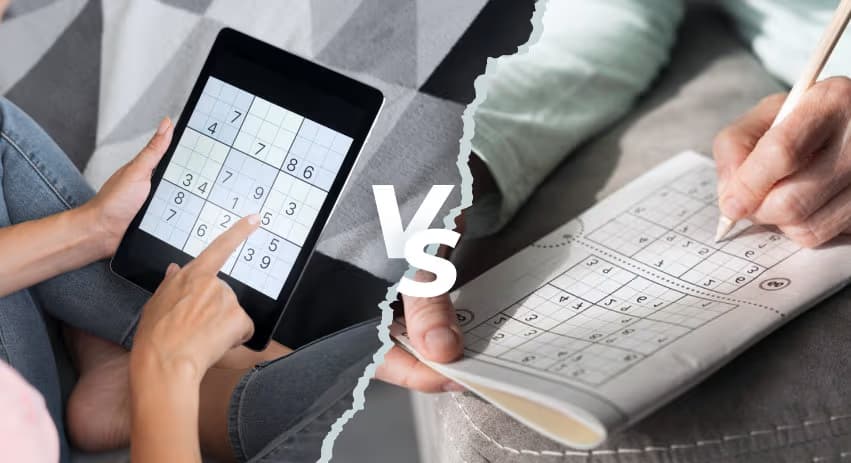
Sudoku Online vs Offline—Pros & Cons Of App & Paper Form
When you know all the benefits of playing Sudoku daily it's only natural to search for a comfortable way of enjoying the game. With modern technologies and the Internet, this puzzle is no longer just a newspaper game, like those you could find in the Washington Post or USA Today
How to Create Your Own Sudoku Puzzles — A Pro’s Guide
Expert guide to How to Create Your Own Sudoku Puzzles with data-backed methods, grading, and pro workflows for unique, human-solvable grids.
Killer Sudoku
Sum the cages · Master the puzzle